
After spending over three years confined to his bed due to a rare condition, a father has taken his first steps once again.
Fehaid, 58, has had a life-changing recovery after receiving treatment at the Royal Free London Private Patients Unit (RFL PPU) for chronic inflammatory demyelinating polyneuropathy (CIDP), a rare autoimmune disorder that affects the nervous system.
His symptoms began in 2022 with weakness in his arms and legs and weight loss, which worsened over three months until he lost all limb movement. He then became bedbound, only able to partially lift his head, speak softly, and had shortness of breath while resting.
He was started on immunosuppressive medication, which initially provided some benefit, but his weakness continued to worsen. He developed throat swelling, further complicating his condition, and was eventually admitted to intensive care.
In March 2025, Fehaid arrived at the Royal Free London Private Patients Unit, where Consultant Neurologist Dr Bal Athwal took charge of his care. The unit is a renowned London centre that specialises in helping those with the most complex and rare conditions.
A series of diagnostic tests revealed that his weakness stemmed from nerve dysfunction, with no detectable nerve activity at the skin’s surface.
He received plasma exchange, resulting in slight arm movement. However, this improvement was temporary, and after two weeks, his severe weakness returned.
He was then given monthly intravenous (IV) treatment while remaining in intensive care.
During this time at the RFL PPU, his care involved a multidisciplinary team of neurologists, pulmonologists, gastroenterologists, immunologists, specialist nurses, physiotherapists, and neurorehabilitation therapists.
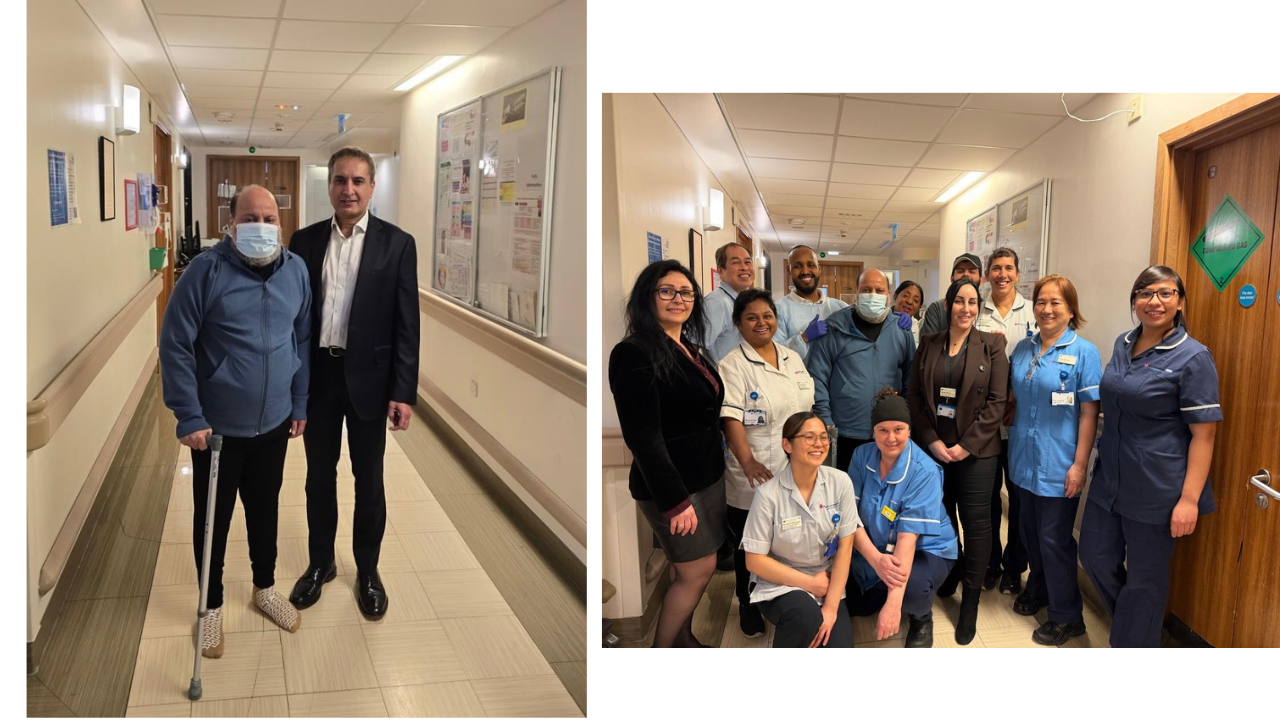
After four months in intensive care, his condition gradually improved, allowing his transfer out of intensive care in October 2025. He gradually regained mobility, progressing from turning in bed to sitting, standing, walking with assistance, and eventually walking independently, with support from nursing and therapy teams.
His recovery was supported by thorough nerve testing and treatment, a multidisciplinary collaboration among specialists, and assistance from leading laboratories. He also received continuous nursing care and regular therapy.
Fehaid said, “It was excellent. Dr Athwal was very clear with the treatment plan. Now I can speak, eat, and walk again without assistance. I can go home. I look forward to taking care of my children again and seeing my whole family and friends.”
Fehaid is now able to move independently and care for himself. He is still being supported by the RFL PPU with guidance for ongoing treatment, and a follow-up planned at the Royal Free Hospital later in the year to check his progress.
Related links: